
Descrizione
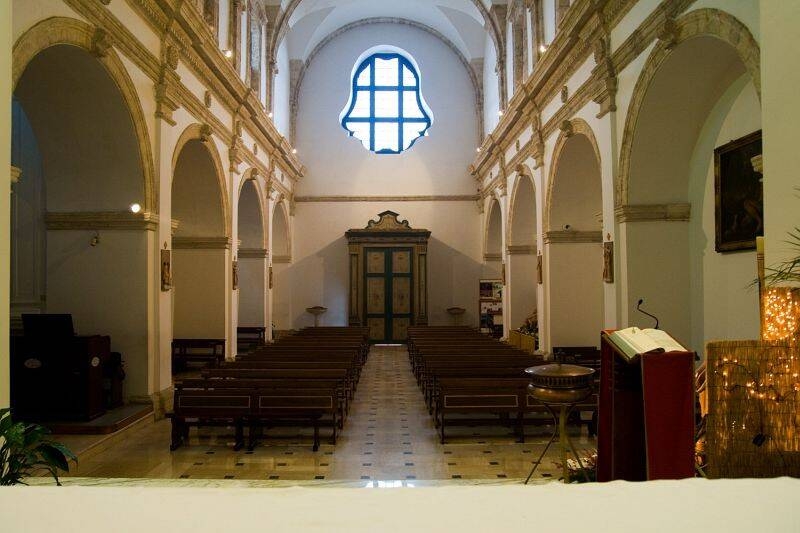
La chiesa di S.Giovanni Battista e di S.Anna, adiacente all'ex convento dei Carmelitani, è comunemente chiamata chiesa Santa Maria del Carmine. Probabilmente il primo e forse unico benefattore legato alla costruzione della chiesa fu Giovanni Battista Indelli, la cui lapide sepolcrale è conservata dietro l'altare maggiore.
La chiesa è stata costruita tra la fine del 1500 e l'inizio del 1600 come è testimoniato sia da una lapide presente in una cappella laterale sia dallo stile e dall'architettura degli altari, tutti costruiti con pietra bianca ostunese.
Il complesso di Santa Maria del Carmine nasce su di un terreno venduto dai frati del convento di san Francesco d'Assisi ai Carmelitani per duecento ducati, denaro che fu dato a questi ultimi dall'Università di Monopoli.
Nella seconda metà del Settecento la chiesa venne modificata, assumendo un aspetto più barocco che conserva tuttora. In particolare sulla facciata è stato realizzato un finestrone che ha alleggerito il prospetto e ha dato maggiore luminosità all'unica navata interna della chiesa. Di particolare importanza sono quattro tele di autori ignoti ma con un chiaro richiamo al Caravaggio: San Giovanni Battista, San Sebastiano, l'Annunciazione e la Madonna di Loreto. Le due pile per l'acqua santa e il battistero in pietra scolpita risalgono al Quattrocento. Interessante è l'ornato ligneo con trittico del XII secolo dietro l'altare.
Attualemte l'ex convento è sede dell'ospedale civile S. Giacomo in Largo Simone Venezini, mentre la chiesa è aperta al pubblico ed è anche sede di parrocchia. La chiesa ha due aperture, una interna che serve per l'accesso di tutti coloro che si trovano nell'ospedale e un'altra esterna per i defedi.
Sul sagrato è stata collocata ultimamente una statua bronzea del beato Padre Pio da Pietrelcina.
Per maggiori informazioni, vedi le fonti:
- Pepe, F. (1996) Monopoli città unica Guida Turistica e Culturale, Monopoli, Editore Zaccaria;
- Campanelli, G. (1989) Monopoli guida turistica, Fasano, Editore Schena;
- Indelli, G. (2000) Istoria di Monopoli, Fasano, Editore Schena.
*******
Contatti:
Chiesa S. Maria del Carmine
Diocesi di Conversano-Monopoli
Largo Simone Veneziani, 25 - 70043 Monopoli (BA)
Tel. (+39) 080 742858
smcarmine.monopoli@libero.it

The church of S.Giovanni Battista and S.Anna, adjacent to the former Carmelite convent, is commonly called the church of Santa Maria del Carmine. Probably the first and perhaps only benefactor linked to the construction of the church was Giovanni Battista Indelli, whose tombstone is preserved behind the main altar.
The church was built between the end of the 1500s and the beginning of the 1600s as evidenced both by a plaque in a side chapel and by the style and architecture of the altars, all built with white Ostuni stone. The complex of Santa Maria del Carmine was born on land sold by the friars of the convent of San Francesco d’Assisi to the Carmelites for two hundred ducats, money that was given to the latter by the University of Monopoli.
In the second half of the eighteenth century the church was modified, taking on a more baroque appearance which it still retains today. In particular, a large window was created on the facade which lightened the front of the church and gave greater brightness to the single internal nave. Of particular importance are four canvases by unknown authors but with a clear reference to Caravaggio: Saint John the Baptist, Saint Sebastian, the Annunciation and the Madonna of Loreto. The two holy water stacks and the sculpted stone baptistery date back to the fifteenth century. The wooden decoration with a 12th centrury triptych behind the altar is interesting.
The former convent is actually home to the S.Giacomo civil hospital in Largo Simone Veneziani, while the church is open to the public and is also the seat of the parish. The church has two openings, and internal one which is used for access by all those who are in the hospital and another external one for the defective. A bronze statue of the blessed Padre Pio of Pietrelcina was recently placed in the churchyard.
Traduzione: Francesco Allegretti, tirocinio formativo a.a.2023/24 presso URP