Descrizione
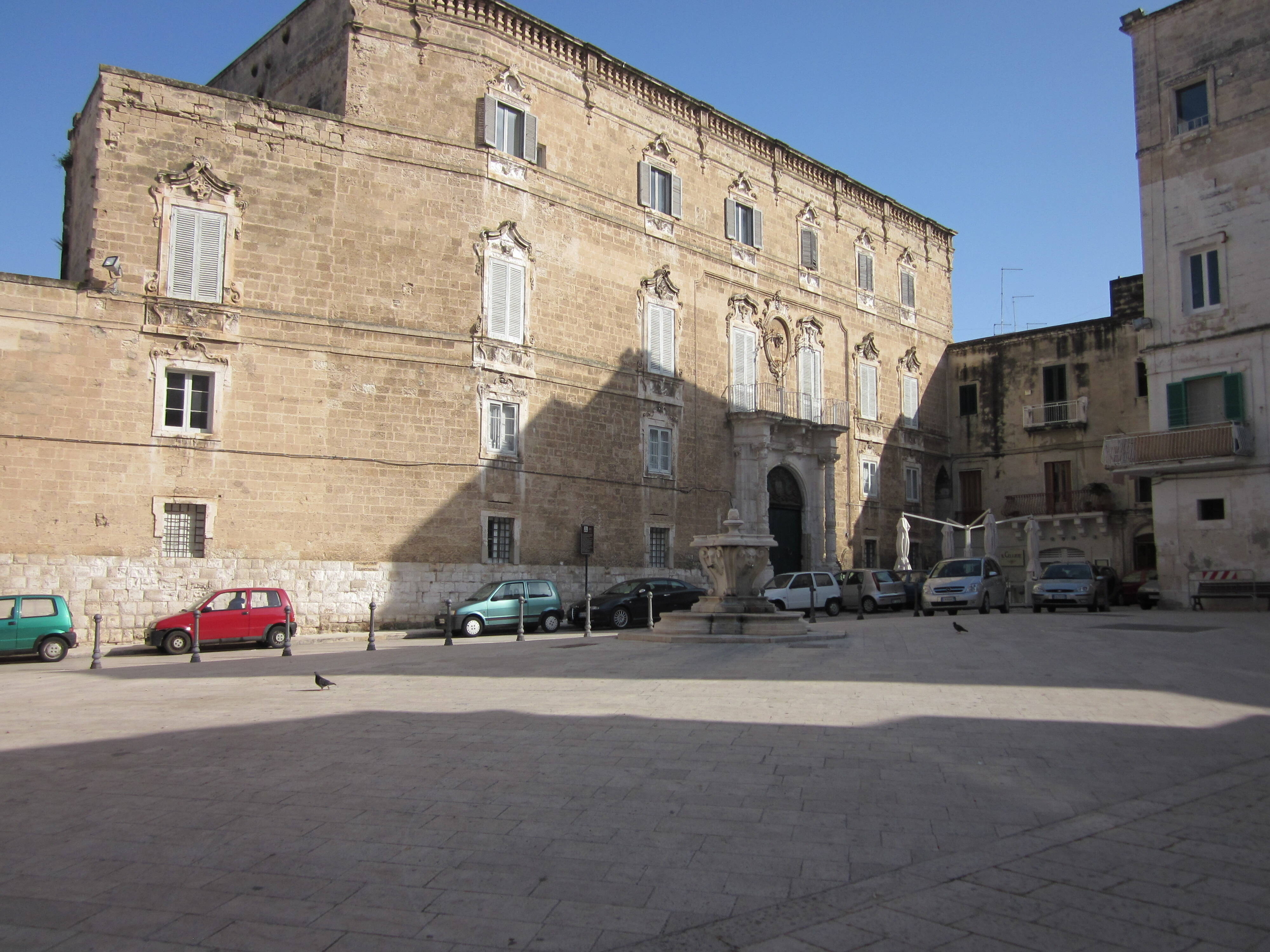
Piazza Palmieri è uno scrigno che racchiude in sé diversi livelli di frequentazione antichissimi, a iniziare dal 1500 a.C., età del bronzo. Infatti la piazza è localizzata sul promontorio dove è sorto il primo nucleo cittadino, presso l’antica chiesa di S. Pietro. Sul sito è stata edificata una delle prime sedi del governo con lo stemma cittadino sull’ingresso, oltre una torre civica trasformata in campanile.
La sua denominazione è dovuta alla presenza di diverse case palazzate della nobile famiglia Palmieri, in particolare quella eretta da Francesco Paolo nel 1767, sede dal 1927 di un Asilo e di una Scuola, quest’ultima dal 1965 trasformata in Istituto Statale d’Arte fino al 1980.
Fondale della piazza sono i prospetti laterali, con le loro entrate secondarie, della chiesa ex parrocchiale di S. Pietro e quella dei padri teresiani (propriamente del convento dei carmelitani scalzi sotto il titolo di SS. Giovanni Battista ed Anna) denominata chiesa S. Teresa dove nel 1955 si è trasferita la parrocchia.
Nel 1818 l’ex convento ospita la Casa Santa, denominato nel 1860 Orfanotrofio femminile, diventata poi Asilo Infantile nel 1903. Proprio per l’educazione delle orfanelle nel 1916 si apre una “Scuola di Taglio, Ricamo e di altri lavori donneschi”, retto dalle suore d’Ivrea, chiusa nel 1984. L’immobile è poi usato dal Comune come scuola elementare fino al 1995.
La piazza anticamente accoglieva anche la vecchia casa palazzata degli Affatati, passata agli Sforza e quindi nel 1687 alla famiglia Sersale. Abbattuta nel ‘800 e parzialmente ricostruita, sarà utilizzata per un periodo come locale-officina della “Scuola di arti e mestieri” per poi essere rasa al suolo nel secondo dopoguerra per far posto all’attuale risistemazione della piazza.

Piazza Palmieri is a treasure chest that contains different levels of very ancient attendance, starting from 1500 BC, the Bronze Age. In fact, the square is located on the promontory where the first city center arose, near the ancient church of S.Pietro. One of the first government offices was built on the site with the city coat of arms on the entrance, as well as a civic tower transformed into a bell tower.
Its name is due to the presence of several palatial houses of the noble Palmieri family, in particular the one built by Francesco Paolo il 1767, home since 1927 to a kindergarten and a school, the latter transformed into a State Institute of Art in 1965 until to 1980.
The backdrop of the square are the side fronts, with their secondary entrances, of the former parish church of S.Pietro and that of the Theresian fathers (specifically of the convent of the Discalced Carmelites under the title of SS.Giovanni Battista and Anna) called S.Teresa church where the parish moved in 1955.
In 1818 the former convent hosted the Holy House, called a female orphanage in 1860, which later became a nursery school in 1903. In 1916, a “School of Cutting, Embroidery and other women’s work” was opened for the education of orphans, run by the nuns of Ivrea, closed in 1984. The property was then used by the Municipality as an elementary school until 1995.
The square formerly also housed the old palace house of the Affatati, which passed to the Sforza family and then in 1687 to the Sersale family. Demolished in the 19th century and partially rebuilt, it was used for a period as a workshop of the “School of Arts and Crafts” before being razed to the ground after the Second World War to make way for the current reorganization of the square.
Traduzione: Francesco Allegretti, tirocinio formativo a.a.2023/24 presso URP